

The Biggest Threat to Developer Productivity Isn't Coding
Developer Productivity

The Biggest Threat to Developer Productivity Isn't Coding

The Biggest Threat to Developer Productivity Isn't Coding


The Biggest Threat to Developer Productivity Isn't Coding

Ask almost any engineering leader why developer productivity is slowing down, and you'll hear familiar answers.

  • "We need more developers."
  • "We need better AI coding tools."
  • "We need faster hardware."
  • "We need another sprint."

While those investments may improve certain aspects of software delivery, they rarely address the real problem.

The biggest obstacle to developer productivity isn't writing software.

It's everything developers have to do after writing software.

Think about how much time engineering teams spend waiting.

Waiting for environments to become available.

Waiting for test results.

Waiting for QA feedback.

Waiting for bug triage meetings.

Waiting for release approvals.

Waiting for another team to finish their work.

None of these activities create customer value, yet they consume a significant portion of every engineer's day.

Modern software organizations don't have a coding problem.

They have a quality workflow problem.

The Hidden Cost of Context Switching

Many executives assume developers spend most of their day building new features. The reality is very different.

A typical developer's day often includes fixing defects, reproducing production issues, reviewing pull requests, updating Jira tickets, searching through documentation, answering questions from QA, and switching between multiple engineering tools.

Every interruption comes with a cost.

Research consistently shows that context switching reduces focus, increases cognitive load, and slows problem-solving. Even brief interruptions can take several minutes to recover from, and over the course of a day, those minutes add up to hours of lost productivity.

The goal shouldn't be to help developers write code faster.

It should be to protect their ability to stay focused on engineering.

Quality Engineering Should Remove Friction And Not Create It

Traditional QA models often position testing as the final checkpoint before a release. Developers complete their work, hand it off to QA, wait for feedback, fix defects, and repeat the cycle until the application is finally approved.

That process worked when software was released a few times each year.

It doesn't work in a world of continuous integration and continuous delivery.

Modern Quality Engineering has a different mission.

Rather than acting as a gatekeeper, Quality Engineering should function as an enablement organization that removes friction from the software development lifecycle.

Instead of asking:

"How do we test this application?"

Forward-thinking engineering teams ask:

"How do we help developers build high-quality software from the very beginning?"

That subtle change in mindset has a profound impact on developer productivity.

The Productivity Killers Most Organizations Ignore

Developer productivity rarely suffers because engineers can't solve difficult technical problems.

It suffers because of hundreds of small inefficiencies that occur every day.

One common example is manual testing requests.

A developer finishes a feature and submits it for validation. QA prepares test data, schedules execution, asks clarifying questions, and documents the results. What could have been validated in minutes often takes days.

Organizations practicing Quality Engineering eliminate much of this delay through automated regression testing integrated directly into CI/CD pipelines. Developers receive immediate feedback without waiting for another team.

Another common challenge is inconsistent testing frameworks.

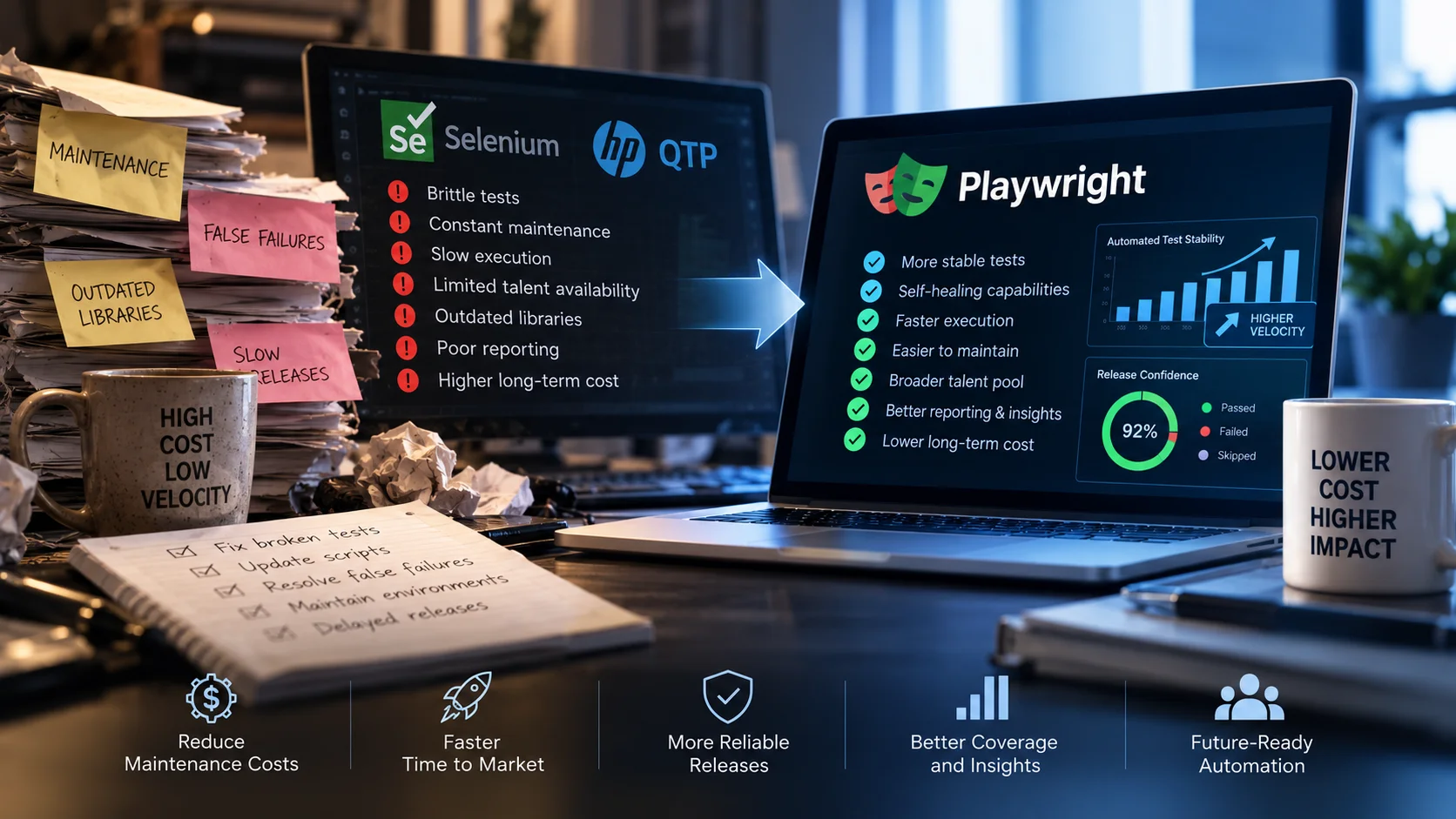
One team automates with Playwright.

Another still uses Selenium.

API teams rely on Postman, while performance engineers work in JMeter. Reporting is scattered across multiple dashboards, each with different metrics and terminology.

Every additional framework increases onboarding time, maintenance effort, and operational complexity.

Too Many Tools, Not Enough Integration

  • Today's engineering organizations often own dozens of specialized tools.
  • Test management platforms.
  • Defect tracking systems.
  • UI testing frameworks.
  • API testing tools.
  • Performance testing solutions.
  • Security scanners.
  • Release management software.
  • Documentation repositories.
  • Individually, these tools provide value.
  • Collectively, they create fragmentation.
  • Developers spend more time navigating disconnected systems than solving customer problems.

High-performing organizations simplify the experience by adopting a unified Quality Engineering platform that connects testing, traceability, reporting, release readiness, and quality analytics into a single workflow.

Instead of searching multiple systems for answers, developers gain one trusted source of quality information.

Build Once. Reuse Everywhere.

One of the greatest opportunities to improve engineering productivity is eliminating duplicate work.

Too often, every development team creates its own automation framework, utility libraries, CI/CD integrations, reporting dashboards, and testing standards.

While this may solve short-term problems, it creates long-term maintenance challenges.

Leading engineering organizations standardize on shared assets that every team can leverage.

These include enterprise automation frameworks, reusable authentication modules, common API libraries, standardized CI/CD templates, centralized test data management, and shared reporting capabilities.

Rather than solving the same problems repeatedly, teams build once and reuse everywhere.

The result is greater consistency, lower maintenance costs, and faster software delivery.

Shift Quality Left to Shift Productivity Right

Developer productivity improves dramatically when quality begins before development starts.

Quality Engineers should participate during planning, architecture reviews, and requirements discussions and not simply after features have been completed.

By providing clear acceptance criteria, requirement traceability, API contracts, reusable automation, and built-in quality guardrails, developers spend less time interpreting requirements and more time building software.

Quality becomes something that is engineered into the product rather than inspected afterward.

AI Will Improve Productivity in Unexpected Ways

Much of today's discussion around Artificial Intelligence focuses on generating code.

That is only part of the opportunity.

The greater value lies in helping developers avoid repetitive engineering work altogether.

AI is already capable of assisting with:

  • AI Test Case Creation
  • API Test Generation
  • Documentation
  • Code Reviews
  • Root Cause Analysis
  • Defect Intelligence
  • Regression Test Selection
  • Release Risk Analysis

Rather than replacing engineers, AI reduces the amount of manual coordination required throughout the development lifecycle.

Developers remain focused on solving business problems while AI automates repetitive engineering activities.

The Future Role of Quality Engineering

The role of the Quality Engineer is evolving rapidly.

Tomorrow's Quality Engineers won't spend most of their time executing manual tests or repairing broken automation scripts.

Instead, they'll focus on improving the entire engineering ecosystem.

They'll build enterprise automation frameworks, simplify CI/CD pipelines, eliminate flaky tests, standardize engineering practices, improve test data management, and provide engineering teams with actionable Quality Intelligence that supports faster, more confident release decisions.

Their mission won't simply be testing software.

It will be enabling developers to do their best work.

Questions Every Engineering Leader Should Ask

If improving developer productivity is one of your organization's strategic objectives, consider these questions:

  • How much developer time is spent waiting on quality-related activities?
  • How many testing frameworks are being maintained across engineering teams?
  • Are developers working from a unified quality platform or a collection of disconnected tools?
  • How much engineering effort is spent maintaining automation rather than creating customer value?
  • Does your quality organization accelerate software delivery or unintentionally slow it down?

The answers often reveal opportunities that have little to do with writing more code.

Final Thoughts

Developer productivity isn't measured by the number of lines of code written or the number of features completed in a sprint.

It's measured by how efficiently engineering teams transform ideas into reliable, high-quality software.

Quality Engineering plays a much larger role in that process than many organizations realize.

When QA provides unified frameworks, standardized automation, integrated CI/CD pipelines, intelligent quality analytics, and actionable release insights, developers spend less time navigating complexity and more time building products that matter.

The engineering organizations that lead the next decade won't simply hire more developers or purchase more tools.

They'll build environments where Quality Engineering removes friction, AI handles repetitive work, and developers remain focused on innovation.

Because the most productive developers aren't necessarily the fastest coders.

They're the engineers who spend the least amount of time fighting the delivery process and the most amount of time solving meaningful problems.