The QA Manager Role Is Being Rewritten
QA Leadership

The QA Manager Role Is Being Rewritten

The QA Manager Role Is Being Rewritten

The QA Manager Role Is Being Rewritten

For decades, the responsibilities of a QA Manager were relatively straightforward. Success was measured by executing test plans, managing testing teams, and ensuring defects were identified before software reached production.

Typical responsibilities included:

  • Developing test plans and test strategies
  • Managing manual and automated testing teams
  • Reviewing defect reports and prioritizing fixes
  • Approving software releases
  • Reporting pass and fail rates
  • Measuring test execution and completion metrics

That model worked when organizations released software every few months.

It does not work in 2026.

Today's engineering organizations deploy software multiple times each day. Developers use AI to generate code. Product teams expect continuous delivery. Executive leadership demands faster innovation without increasing production risk.

As a result, the role of QA leadership has fundamentally changed.

Organizations embracing this evolution are transforming QA Managers into Quality Engineering Leaders. Those that fail to adapt are finding themselves overwhelmed by technical debt, unstable automation, fragmented tooling, and outdated quality processes.

QA Leadership Is No Longer About Managing Testers

One of the biggest misconceptions in software quality is that leadership is measured by the size of the QA team.

Modern Quality Engineering leaders spend less time managing execution and far more time enabling engineering organizations.

Instead of asking:

How many test cases did we execute?

Today's leaders ask questions that directly influence business outcomes.

  • Are we reducing release risk?
  • Is automation delivering measurable business value?
  • Where are our largest test coverage gaps?
  • Are developers receiving quality feedback early enough?
  • What quality trends are emerging across engineering?

Testing has become an engineering capability.

Leadership has become an organizational capability.

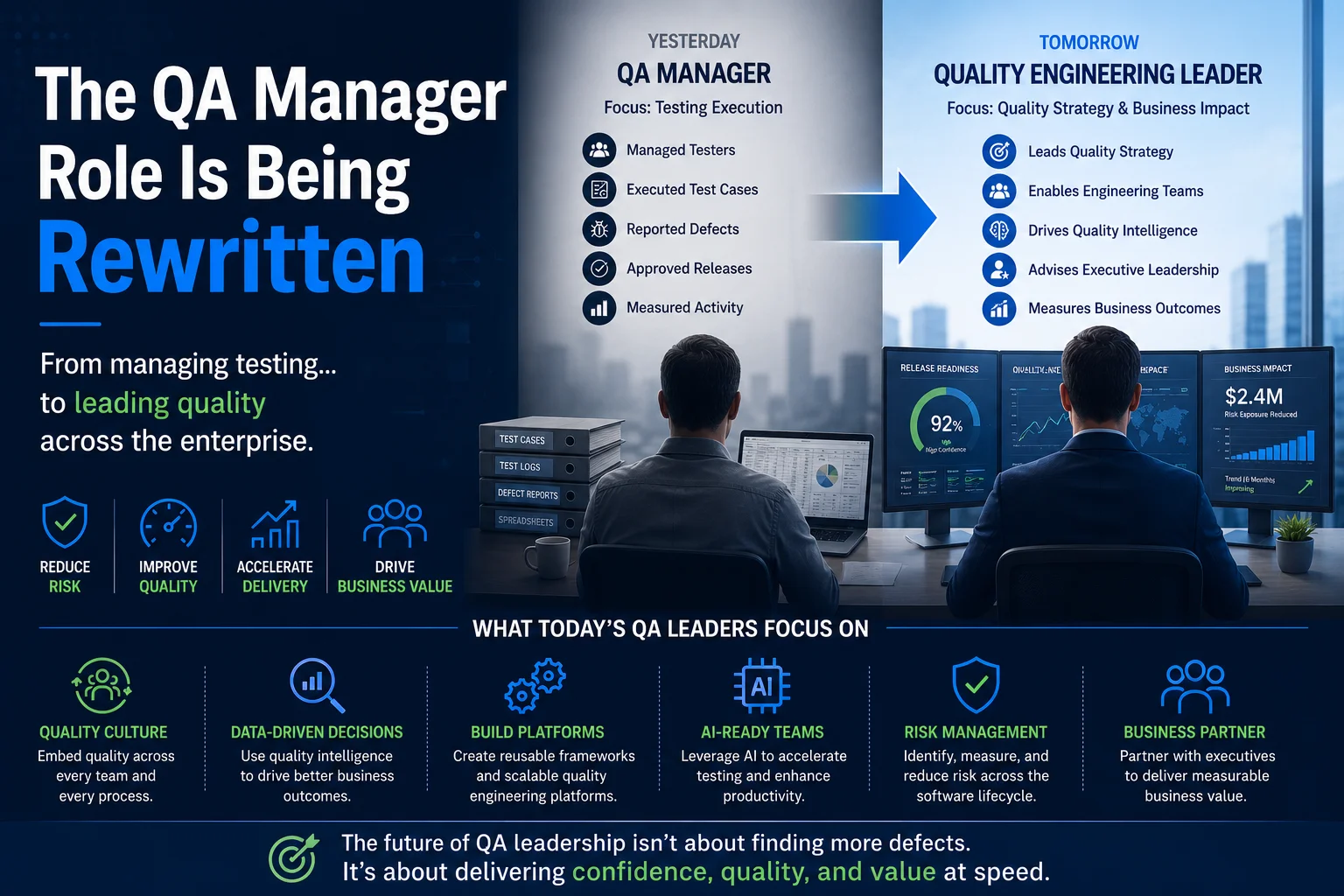
The Evolution of QA Leadership

Traditional QA Manager 2026 Quality Engineering Leader
Managed manual testing Leads enterprise Quality Engineering strategy
Reported test execution Reports Release Readiness and business risk
Owned QA activities Enables engineering-wide quality
Counted defects Measures operational and business risk
Approved releases Advises executive leadership
Managed testing teams Builds engineering platforms and standards
Focused on individual projects Builds organizational capabilities

The title may remain the same.

The responsibilities have completely changed.

Leadership Begins Before Testing Starts

The best QA leaders spend surprisingly little time discussing testing.

Instead, they focus on the activities that influence software quality before a developer writes a single line of code.

These include:

  • Requirement quality and clarity
  • Architecture reviews
  • Application testability
  • Automation strategy
  • API-first design
  • Engineering standards
  • CI/CD quality gates
  • Quality Governance

Their objective is not simply finding defects.

Their objective is preventing defects from being introduced in the first place.

Four Responsibilities of Modern QA Leadership

1. Build a Quality Engineering Culture

Quality no longer belongs exclusively to the QA organization.

Successful engineering organizations distribute quality ownership across every discipline.

  • Developers own unit testing.
  • Architects design for testability.
  • Product Managers define measurable acceptance criteria.
  • DevOps automates deployment quality gates.
  • Security teams validate compliance.
  • QA Leaders align every discipline around a shared quality strategy.

Culture, not process, is the greatest responsibility of today's QA leader.

2. Lead Through Data, Not Opinions

Executive leadership does not need another spreadsheet showing test execution results.

They need decision support.

Modern QA leaders leverage Quality Intelligence to answer business critical questions.

Instead of reporting:

  • 4,200 automated tests executed
  • 98% automation pass rate
  • 12 open defects

They answer:

  • What is our Release Readiness Score?
  • Which customer journeys remain at risk?
  • Which applications require engineering investment?
  • How has software quality changed over the past six months?
  • Where are future production risks emerging?

The conversation shifts from activity to outcomes.

3. Build Platforms Instead of Projects

Historically, every application built its own testing framework.

Every team created its own utilities.

Every project repeated the same work.

Modern organizations invest in Enterprise Quality Engineering platforms that provide:

  • Reusable automation frameworks
  • Shared automation libraries
  • Centralized Test Case Management
  • Standardized reporting
  • Integrated Quality Dashboards
  • Common engineering standards
  • Enterprise-wide scalability

One platform can support dozens of engineering teams.

That is scalable leadership.

4. Prepare Teams for Artificial Intelligence

Artificial Intelligence is transforming software engineering faster than any previous technology.

Developers are already using AI to generate:

  • Source code
  • Unit tests
  • Documentation
  • API mocks
  • Infrastructure templates

Soon, AI will generate complete application workflows.

Rather than resisting this change, QA leaders should prepare their organizations for it.

Future Quality Engineers will spend less time writing automation manually and more time:

  • Validating AI-generated test cases
  • Reviewing AI-generated automation
  • Building enterprise prompt libraries
  • Governing AI quality policies
  • Measuring AI effectiveness
  • Designing intelligent testing strategies

Leadership means preparing today's teams for tomorrow's engineering landscape.

The Skills Every QA Leader Needs in 2026

Technical credibility is no longer optional.

Software Engineering

  • CI/CD Pipelines
  • Git Workflows
  • Cloud Native Architectures
  • Microservices
  • APIs

Modern Testing

  • UI Testing
  • API Testing
  • Mobile App Testing
  • Accessibility Testing
  • Performance Testing
  • Security Testing

Quality Intelligence

  • Test Coverage Analysis
  • Requirement Traceability
  • Defect Analytics
  • Release Risk Analysis
  • Quality KPIs
  • Predictive Quality Analytics

Artificial Intelligence

  • AI Test Generation
  • Large Language Models
  • Prompt Engineering
  • Intelligent Regression
  • AI Governance

Tomorrow's QA leader must be both a technology strategist and a business leader.

What Executive Leadership Expects

Today's CIOs and CTOs expect QA leadership to influence far more than testing.

Quality leaders should actively contribute to:

  • Engineering productivity
  • Release predictability
  • Customer experience
  • Operational risk reduction
  • Regulatory compliance
  • Software Quality Analytics
  • AI adoption strategies
  • Enterprise technology direction

QA has earned a permanent seat at the executive table, but only when it communicates in the language of business outcomes.

Looking Toward 2030

The next five years will reshape Quality Engineering more than the previous twenty.

Organizations should expect to see:

  • AI automating repetitive testing activities
  • Continuous Testing becoming autonomous
  • Quality Orchestration coordinating engineering workflows
  • Data driven Quality Governance
  • Quality Intelligence predicting failures before they occur

QA leaders who continue managing execution alone will struggle.

Those who embrace engineering leadership will become some of the most influential technology leaders within their organizations.

Five Questions Every QA Leader Should Ask

Before your next release, ask yourself:

  • Are we measuring software quality or simply measuring testing activity?
  • Does executive leadership understand the business value our organization provides?
  • Can we explain Release Readiness using measurable data instead of opinions?
  • Are our developers enabled by QA or dependent on QA?
  • Is our team preparing for AI or simply reacting to it?

The answers will determine whether your organization is prepared for the future of software quality.

Final Thoughts

The role of QA leadership is no longer to manage testing.

It is to build an engineering organization where quality is designed, measured, governed, and continuously improved.

The best QA leaders of 2026 will not be recognized because they found the most defects.

They will be recognized because they built organizations where defects became increasingly rare, engineering teams became more productive, and executive leaders could make confident, data driven release decisions.

That is the future of QA Leadership.

It is no longer about leading a QA team.

It is about leading the quality of the entire engineering organization.